RAG or fine-tuning? Compare costs, data freshness, compliance, and accuracy to make the right decision about enterprise AI architecture. Practical guidance inside.
June 11
10 mins
The Question That Keeps Coming Up
Almost every enterprise AI strategy discussion hits the same fork in the road. Should the organization fine-tune a model on its own data, or go with RAG? What usually follows is a debate in which everyone is half right, and nobody has the full picture.
So let us break this down plainly.
What Each Approach Actually Does
Fine-tuning is the process of retraining a pretrained language model on your specific data. You feed it thousands of your documents, emails, reports, or conversations, and the model adjusts its internal weights to learn your domain’s patterns, terminology, and style. After training, the model generates answers from memory. It does not look anything up. It just “knows” your stuff, or at least it thinks it does.
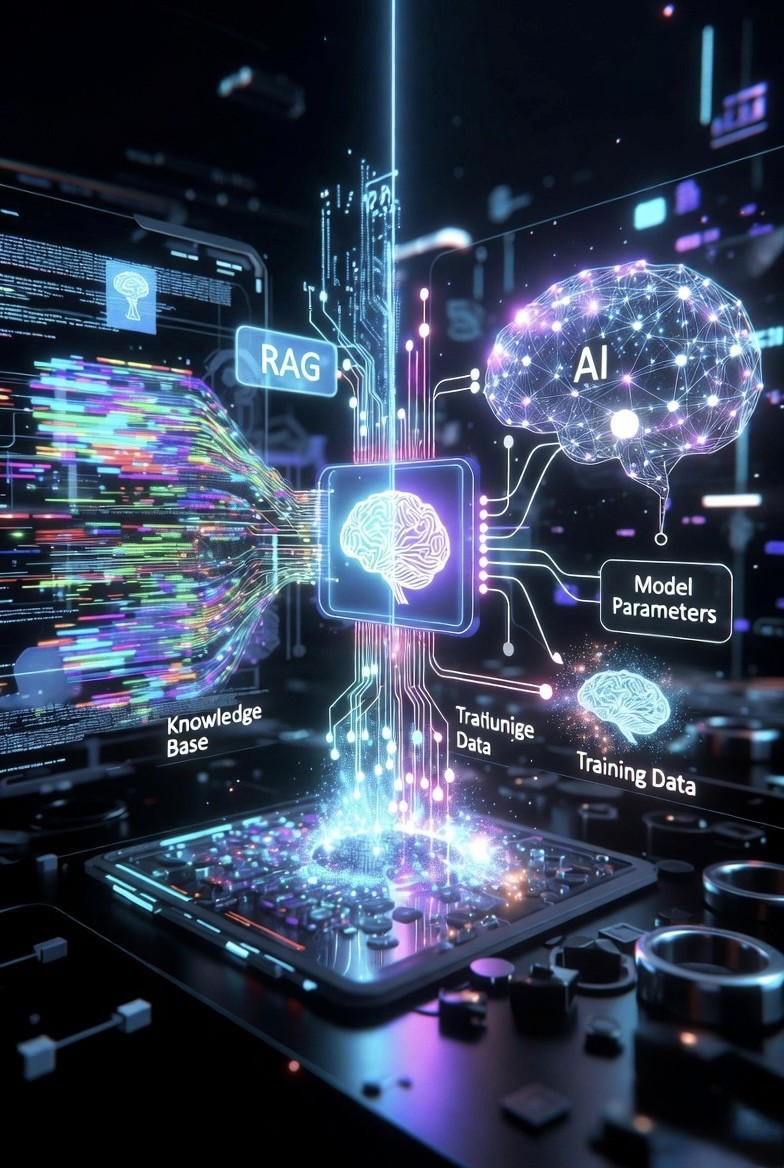
RAG, which stands for Retrieval Augmented Generation, works completely differently. It leaves the base model untouched and adds a search layer on top. When someone asks a question, the system first searches your knowledge base (company wikis, policy documents, manuals, databases), pulls out the most relevant chunks, and feeds them to the model alongside the question. The model then writes an answer grounded in what it just read.
Think of it this way. Fine-tuning is like studying for a closed-book exam. RAG is like taking an open-book test. Both can get you the right answer, but the mechanics and the risks look very different.
Let Us Talk About Money
Fine-tuning is expensive. You need GPU compute time, ML engineers who know what they are doing, carefully curated training data, and multiple rounds of experimentation before the model performs well enough for production. Depending on the model size and data volume, you are looking at anywhere from tens of thousands to hundreds of thousands of dollars. And here is the kicker: you pay that cost again every time your data changes significantly, and the model needs to be retrained.
RAG costs a fraction of that. You need a vector database, an embedding pipeline, and a retrieval system. When your data changes, you reindex the updated documents. No retraining required. For most business use cases, RAG delivers 80 to 90 percent of the accuracy you would get from fine-tuning, at maybe 20 percent of the cost. That math is hard to argue with, and it is why enterprises are choosing RAG for the majority of their generative AI deployments.
The Freshness Problem
This is where RAG wins by a wide margin. Enterprise data is not static. Policies change. Product specs get updated. Regulations shift. Market conditions move daily. A fine-tuned model is frozen in time. It only knows what it learned during its last training run. Want to add last week’s updated compliance policy? You need to retrain, validate, test, and redeploy. That cycle takes days, sometimes weeks.
With RAG, you update the knowledge base, re-embed the changed documents, and the very next query reflects the new information. For any business where accuracy and recency matter (legal, compliance, customer support, product documentation), this alone can tip the scales.
Trust and Traceability
Here is something that does not get enough attention. When a fine-tuned model gives you an answer, you have no idea where that answer came from. It is baked into the model’s parameters, mixed in with everything else it learned during training. If the answer is wrong, you cannot trace it back to a source. You cannot point to a document and say, " This is what the AI based its response on.
RAG gives you that traceability. Every answer includes the documents retrieved to generate it. Users and auditors can verify the source. If something is wrong, you know exactly which document needs correcting. For regulated industries like banking, healthcare, insurance, and legal services, this is not a nice feature. It is a requirement.
Data Privacy and Compliance
Fine-tuning means feeding your proprietary data into a model’s training pipeline. That raises serious questions about data residency, intellectual property, and regulatory compliance, especially under GDPR, India’s DPDP Act, and the EU AI Act. Once your data is baked into a model’s weights, you cannot easily delete it or control how it surfaces in responses.
RAG keeps your data separate from the model. The LLM never trains on your information. It only reads retrieved documents at inference time. This clean separation makes it far easier to implement access controls, enforce data retention policies, manage document-level permissions, and demonstrate compliance during audits.
When Fine-Tuning Still Makes Sense
Fine-tuning is not always the wrong call. If you need a model to write in a very specific style (medical reports in a particular format, legal briefs following a house style), fine-tuning handles that well. If latency is critical and you cannot afford the retrieval step, a fine-tuned model responds faster. If your knowledge base is stable and rarely changes, the retraining cost becomes more manageable.
Some enterprises use a hybrid approach, fine-tuning for tone and style while using RAG for factual knowledge. That way, the model sounds like it belongs to your organization while still pulling accurate, up-to-date information from your knowledge base.
Making the Right Call for Your Business
For most enterprise use cases in 2026 (internal knowledge assistants, customer support bots, document Q&A systems, compliance tools), RAG is the smarter starting point. It costs less, updates faster, provides better traceability, and plays nicer with privacy regulations.
At Sphurix, our AI and GenAI consulting team helps enterprises work through this decision with their specific data, compliance requirements, and business goals in mind. We design and implement production-grade RAG systems, fine-tuned models, and hybrid architectures that actually deliver results. If you are trying to figure out which path is right for your organization, we would love to have that conversation.
