AI‑Powered Email Triaging and Automated Workflow Orchestration for a Global Maritime Operator
Optimize maritime operations with AI-powered email triaging and intelligent workflow orchestration. Automatically classify, prioritize, and route critical communications across global teams. Streamline complex operational processes with adaptive, rule-based automation. Enhance response times, reduce manual workload, and ensure smooth, efficient fleet operations.
Initial Timeline | Engagement | Services | Technology |
6 Months | Fixed Fee | Email integration & triage; Serverless processing; AI classification & extraction; Workflow orchestration; Dashboard & analytics | Microsoft Graph; Azure Logic Apps; Azure Service Bus; Azure Functions; Azure AI Document Intelligence; Azure OpenAI; Power BI; React/Next.js; PostgreSQL |
The Challenge
A rapidly expanding global maritime operator with headquarters in Singapore and six main regional offices was overwhelmed by high volumes of inbound email across operations, commercial, and technical teams. Manual triage created delayed responses, SLA breaches, and limited visibility into workload trends, which in turn increased operational cost and risk across thousands of port calls and contracts. The client needed an enterprise‑grade, secure solution to automatically detect, classify, and route emails; extract actionable data; and surface prioritized work to regional teams while preserving auditability and human oversight.
Our Strategy
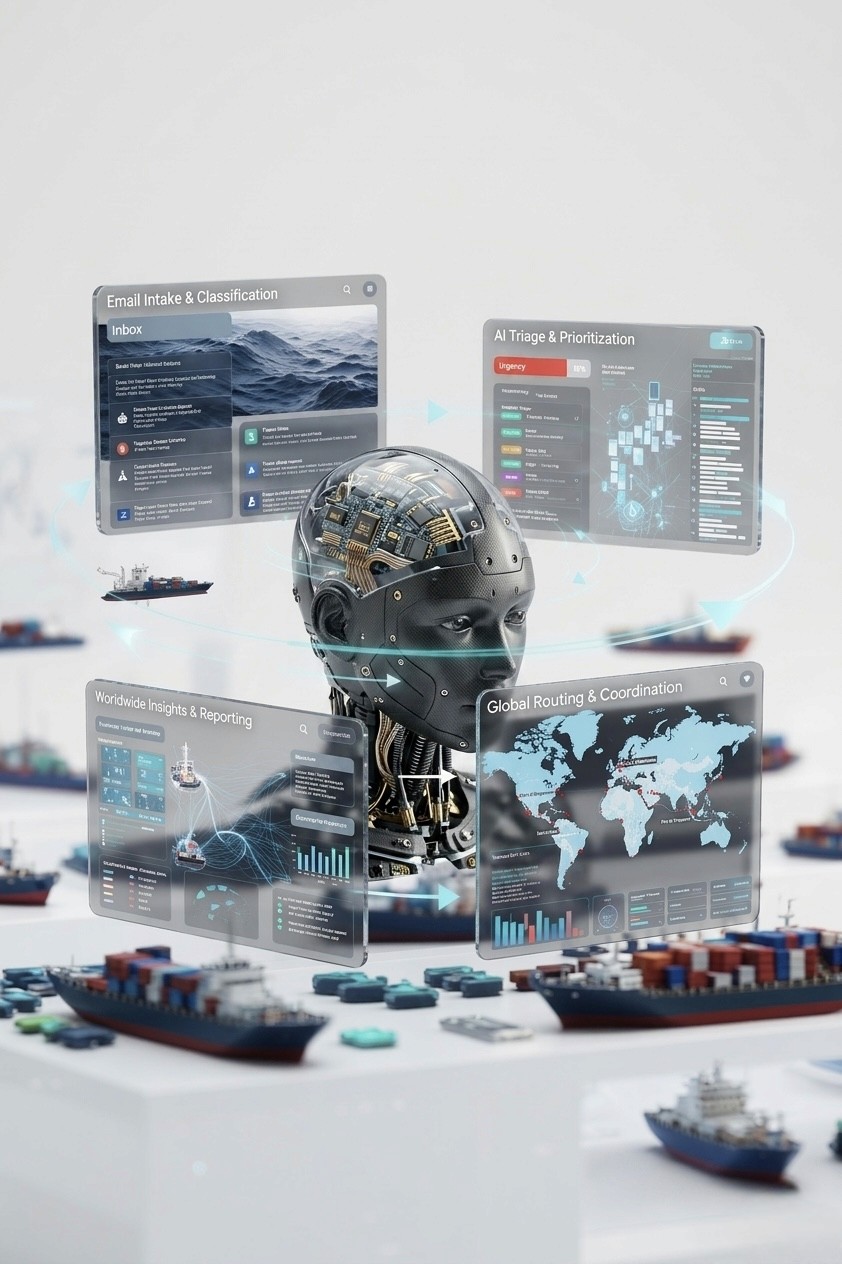
We designed and delivered an end‑to‑end, cloud‑native email triaging platform tailored to the operator’s global scale and regulatory posture. The solution focused on three objectives: speed, consistency, and traceability.
Ingestion and Integration
Mailbox capture: Integrated shared and regional mailboxes using Microsoft Graph and Azure Logic Apps to ensure reliable, centralized ingestion across offices in Singapore, UAE, India, Germany, Malaysia, and representative locations.
Queueing: Used Azure Service Bus to decouple ingestion from processing and to guarantee at least once delivery for high volume periods.
Serverless Processing and AI Classification
Serverless pipeline: Azure Functions normalized messages, extracted attachments, and invoked AI services.
Intent classification: Azure OpenAI models classified emails into categories (operations alert, port service request, commercial inquiry, HR/finance) and assigned priority levels based on intent and historical SLA impact.
Document Understanding and Extraction
Document AI: Azure Document Intelligence and OCR handled PDFs and DOCX attachments, extracting structured fields (vessel name, port, ETA/ETD, service requested, contract references).
Enrichment: Extracted data was matched against internal records (contracts, port schedules) to auto populate downstream workflows.
Orchestration and Routing
Business rules engine: Priority and routing rules sent high urgency items to on call operations teams, commercial queries to regional commercial managers, and finance items to the back office queue.
Human in the loop: A lightweight review step allowed exceptions and high risk items to be escalated to regional leads.
Analytics and Continuous Improvement
Observability: Power BI dashboards tracked triage volumes, SLA adherence, time to first action, and classification accuracy by office.
Feedback loop: Reviewer corrections were fed back to the model training pipeline to improve classification and extraction over time.
Technology and Security Highlights
Azure first architecture to align with enterprise governance and regional data residency needs.
LLM + Document AI for robust intent classification and multimodal extraction.
Serverless, event driven design for elasticity during peak booking and port call windows.
Enterprise security: role based access, audit logging, SPF/DKIM checks on inbound mail, and SOC 2 readiness patterns to meet maritime compliance and safety documentation requirements.x`
Outcomes and Benefits
Significant time savings: Automated triage reduced average time to first action from multiple hours (or days in some regional queues) to minutes for prioritized items.
Reduced manual effort: The operator realized an estimated 60–80% reduction in manual triaging effort, freeing procurement, operations, and commercial staff to focus on exceptions and high value tasks.
Faster response and improved SLAs: Response times improved by 30–50%, reducing demurrage risk and improving port coordination.
Consistent routing and fewer missed items: Standardized classification and routing reduced human error across six main offices and two representative locations.
Actionable analytics: Dashboards provided leadership with workload trends, regional performance, and model accuracy metrics to guide staffing and process improvements.
Scalable, auditable platform: The solution supports thousands of emails per day and includes full audit trails for regulatory and commercial review.
Conclusion
Delivered in a six month fixed fee engagement, the AI Powered Email Triaging solution transformed the maritime operator’s inbound communications into a predictable, auditable, and scalable workflow. By combining mailbox integration, serverless processing, LLM driven classification, and document AI extraction, the platform accelerated operational response, improved SLA adherence, and reduced manual effort—enabling the organization to sustain rapid global growth while maintaining local responsiveness across its international offices.
